Dog Longevity vs Healthspan: Biological Realities for Helping Your Companion Live a Richer, Active Life
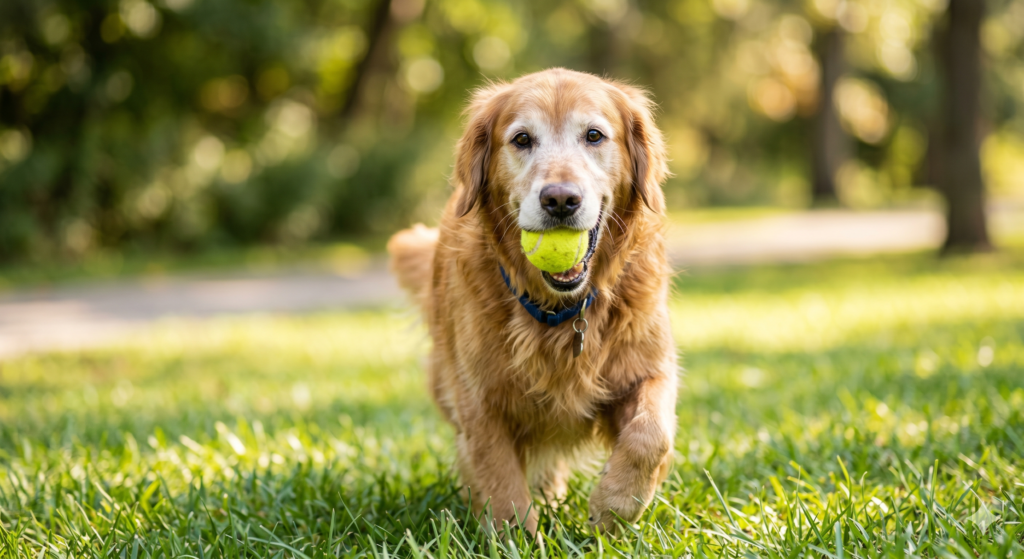
Every person who shares their life with a dog eventually faces a bittersweet reality: our companions age far more rapidly than we do. This compressed timeline provides an intimate window into the biological journey of senior dog health. In recent years, pioneering research in canine geroscience has radically shifted how veterinary professionals and caregivers view this process. We no longer measure the success of an aging dog’s life simply by the number of years on a calendar. Instead, the modern scientific focus balances traditional dog longevity with healthspan—the period of life spent free from chronic, debilitating disease and functional disability.
Veterinary researchers increasingly recognize that while biological aging is universal and continuous, its trajectory is highly modifiable. By shifting our mindset from reactive medicine to proactive, lifelong support, we can compress morbidity into a very brief period at the end of a pet’s life. This comprehensive guide digs deep into the molecular dynamics of canine aging, defines successful aging, and provides practical, validated strategies to maximize the vibrant, active years you share with your dog.
Shifting the Paradigm: Longevity vs. Healthspan in Dogs
For decades, veterinary care focused on maximizing lifespan. However, extending raw chronological life without maintaining structural, behavioral, and metabolic integrity creates a significant dilemma: it can prolong a state of low-quality life marked by multiple chronic diseases. Geroscience aims to synchronize biological health with chronological age, ensuring that a dog’s functional capabilities remain intact for as long as possible.
As a dog grows older, it experiences a progressive physiological decline that naturally reduces its biological capacity to resist, react to, and fully recover from daily environmental stressors. This gradual loss of resilience is heavily driven by the steady accumulation of damage at the microscopic cellular level. When we only track the takvimi (chronological) age, we miss the early, microscopic indicators of decline that happen during midlife—the very period where preventative interventions yield the highest impact.
Defining Successful Aging for Better Dog Longevity
What does successful or healthy aging actually look like in a domestic dog? The World Health Organization (WHO) defines human healthy aging as the process of developing and maintaining functional abilities that support well-being in older age. Because of the unique, codependent relationship between domestic pets and humans, veterinary experts have built upon this foundation to form a tailored, actionable definition specifically for cats and dogs.
According to recent scientific consensus, healthy aging in companion dogs is defined as:
“Aging in which the individual maintains functional capabilities and develops resilience sufficient to meet their own physical, behavioral, social, and emotional needs throughout all adult life stages, while sustaining the human-animal bond.”
Core Pillars of Canine Functional Capability
To turn this definition into actionable care, we must break down the basic biological components that allow an aging animal to function properly every day:
- Physical Functioning: Includes foundational physical elements such as structural muscle strength, core balance, joint flexibility, motor coordination, cardiovascular fitness, and daily energy reserves.
- Sensory Functionality: The precise preservation of vision, hearing, olfaction (smell), taste, and proprioception (the neurological awareness of body position in space).
- Physiological & Metabolic Homeostasis: Clean cellular, tissue, and organ-level processing required to maintain stable internal balance during resting states and physical exertion.
- Cognitive Capabilities: The maintenance of baseline processing speed, short- and long-term memory, and complex executive functions within the brain.
The 12 Hallmarks of Dog Aging: Why Dogs Grow Old
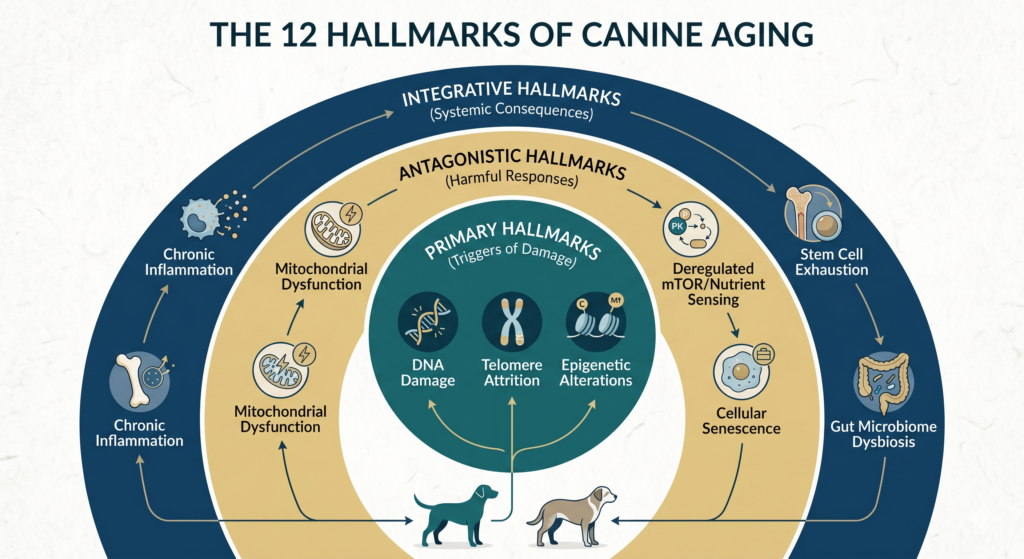
To safely optimize dog longevity, we must first look into the core biological drivers that cause aging. Geroscience categorizes these complex cellular and molecular dynamics into a standard conceptual framework known as the Hallmarks of Aging. These twelve markers are arranged into three distinct, interconnected hierarchical tiers based on how they drive somatic damage over time.
1. Primary Hallmarks: The Triggers of Damage
These are the fundamental, cumulative changes that initiate cellular damage throughout your dog’s body.
- Genomic Instability: Continuous, deleterious changes to nuclear DNA, including somatic mutations, nucleotide deletions, and the unexpected insertion of viral genetic material.
- Epigenetic Alterations: Complex, non-coding modifications to DNA architecture and structural chromosomes that inappropriately modify gene expression without changing the core code.
- Telomere Attrition: The steady shortening of the protective nucleoprotein caps at the ends of chromosomes after successive rounds of cellular replication.
- Loss of Proteostasis: A progressive failure to coordinate and control the correct homeostatic balance of properly folded, functional proteins, leading to toxic intracellular aggregation.
- Disabled Macroautophagy: A decline in the vital lysosomal clearance pathways responsible for removing metabolic waste, worn-out organelles, and intracellular pathogens.
2. Antagonistic Hallmarks: The Harmful Responses
These processes represent the body’s natural compensatory responses to age-related damage, which eventually become destructive themselves.
- Deregulated Nutrient Sensing: Disturbances in cellular pathways (like the metabolic growth axis regulated by Growth Hormone, IGF-1, and the mTOR pathway) that impair a cell’s ability to accurately detect nutrient levels and safely adapt metabolism.
- Mitochondrial Dysfunction: Aging within the cell’s powerhouses that compromises overall bioenergetics, drastically increases the baseline production of destructive reactive oxygen species (ROS), and triggers systemic inflammation.
- Cellular Senescence: An irreversible state where damaged cells permanently lose the ability to divide but resist programmatic destruction, remaining metabolically active to secrete toxic, pro-inflammatory signaling proteins.
3. Integrative Hallmarks: The Systemic Consequences
These hallmarks surface as the direct structural consequences of aging when local homeostatic mechanisms become fully overwhelmed.
- Stem Cell Exhaustion: A sharp decline in the regenerative capability of regional tissue-specific stem cells to divide, renew, and repair local organ damage.
- Altered Intercellular Communication: Deep neuroendocrine, neural, and hormonal signaling deficiencies that disrupt clean communication across different organ systems.
- Chronic Inflammation (Inflammaging): A state of low-level, sterile, systemic vascular inflammation that gradually accelerates tissue destruction and organ decay.
- Dysbiosis: A severe disruption to the complex, delicate microbial ecosystem of the digestive tract, which impairs immune health and organ vitality.
Measuring Dog Biological Age vs. Chronological Age
One of the most exciting breakthroughs in canine geroscience is the development of practical biological aging clocks. Every dog possesses two distinct ages: chronological age (the simple measure of elapsed calendar time) and biological age (the precise measure of accumulated cellular damage and physiological reserve).
By mathematically modeling population data, researchers can calculate a dog’s specific biological status using common clinical biomarkers. The difference between these two points is known as the age gap. A positive age gap indicates that an animal is aging rapidly, highlighting a high risk for early frailty and mortality.
Early data from community science initiatives like the global Dog Aging Project show that biological aging clocks can track distinct variations between sizes and breeds. For example, large-breed dogs show accelerated biological aging on epigenetic clocks compared to smaller breeds. Measuring these shifts early in adult life provides primary care veterinarians with a valuable window to introduce targeted lifestyle changes before clinical diseases emerge.
Clinical Screening Tools That Support Dog Longevity
Proactive senior dog health management relies heavily on validated, longitudinal monitoring tools. Relying strictly on a basic visual exam can miss subtle changes in physical function and neurological integrity. The following clinical approach provides a structured template for tracking aging across all adult life stages:
Key Veterinary Frameworks for Longevity Tracking
| Assessment Component | Specific Focus & Parameters | Validated Tools & Clinical Guidelines |
| Functional Mobility | Preserving independent physical movement, posture, and spatial ability. | Liverpool Osteoarthritis in Dogs (LOAD), Canine Geriatric Functional Scoring Systems. |
| Pain Identification | Pinpointing hidden, chronic structural discomfort arising from orthopedic decay. | AAHA Pain Management Guidelines, Orthopedic Metrology Instruments. |
| Cognitive Tracking | Early screening for neurodegenerative decline and behavioral anomalies. | Canine Dementia Scale (CADES), Longitudinal Behavioral Profiles. |
| Nutritional & Mass Audit | Monitoring for age-associated sarcopenia, cachexia, or metabolic shifts. | Regular Body Condition Score (BCS), Muscle Condition Score (MCS). |
| Caregiver Burden Tracking | Assessing the emotional, practical, and financial impact on the family. | Pre-clinic Patient Questionnaires, Health-Related Quality of Life (HRQoL) Tools. |
Proactive Strategies to Optimize Dog Healthspan
Current research suggests that several foundational lifestyle interventions can positively alter a dog’s aging trajectory. Implement these science-backed pillars early in adulthood to maintain resilience and enhance functional capability:
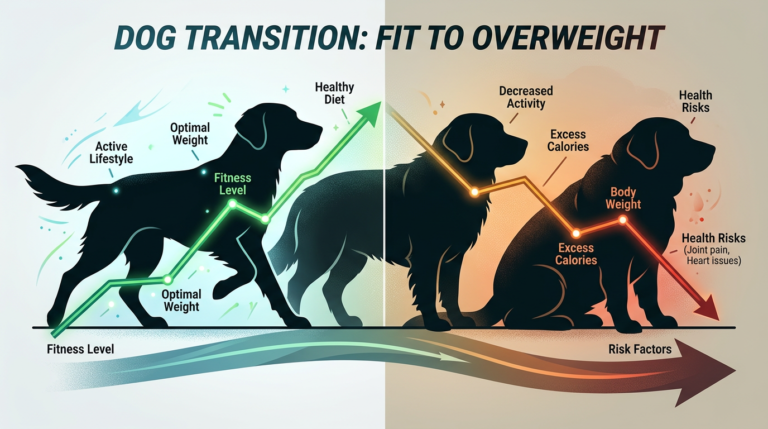
- Caloric Optimization: Avoid chronic overfeeding. Long-term canine cohort studies demonstrate that dogs maintained in a lean body condition score throughout life experience a significantly longer lifespan and healthspan compared to those fed excess calories.
- Environmental Enrichment: Engage your dog in cognitive workouts, scent games, and controlled socialization to slow age-associated mental decline. Lower cognitive performance in aging dogs has been associated with distinct alterations in gut microbiota, highlighting a strong gut-brain axis.
- Targeted Activity Modification: While high-impact exercise may need adjustment as joint integrity shifts, maintaining consistent, low-impact daily movement preserves core muscle strength, balance, and sensory proprioception.
How the Human-Animal Bond Supports Dog Longevityourney of Aging
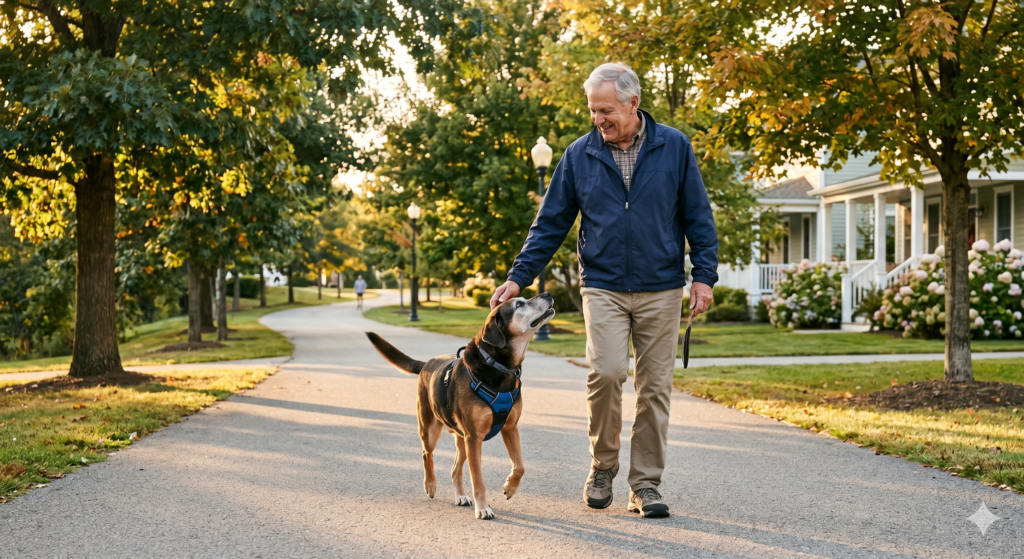
The experience of canine aging does not occur in isolation; it is deeply interwoven with the health and social environment of the caregiver. Data from public health surveys indicate that adults over the age of 50 who regularly walk a dog are significantly more likely to achieve target physical activity metrics and report a strong, supportive sense of community capital. Furthermore, dog walking helps preserve optimal walking speed in late life—a critical clinical indicator of balance that prevents dangerous falls and supports independent human living.
However, caring for an aging animal with multiple chronic comorbidities can place immense emotional, logistical, and financial stress on an owner. Changes in a senior dog’s daily behavior—such as nighttime wandering, vocalization, or loss of house training—can cause caregiver distress and strain the household.
To preserve this vital bond, veterinary medicine is moving toward a model of “bond-centered care”. This approach actively addresses the family’s logistical needs alongside the dog’s medical requirements. Minimizing the adverse daily impacts of a pet’s aging process ensures that owners can comfortably and safely continue to fulfill their dog’s physical and emotional needs.
Frequently Asked Questions (FAQs)
What causes aging in dogs?
Aging is driven by a complex web of molecular changes classified as the 12 Hallmarks of Aging. These include structural DNA mutations (genomic instability), the erosion of chromosomal caps (telomere attrition), impaired cellular waste clearing (macroautophagy), and chronic, systemic inflammation (inflammaging). These factors gradually decrease a dog’s biological resilience and functional reserves.
How does healthspan differ from lifespan in dogs?
Lifespan refers strictly to the total number of chronological years a dog lives before death or euthanasia. Healthspan is the specific portion of that life spent in a healthy, active state, completely free from debilitating chronic diseases or severe functional limitations. Geroscience aims to extend healthspan so that it matches total lifespan as closely as possible.
Can you measure a dog’s biological age?
Yes, early research in canine geroscience has successfully generated biological aging clocks. These sophisticated algorithms analyze unique somatic biomarkers, such as epigenetic DNA methylation patterns or specific changes in standard blood biochemistry and hematology. This analysis determines an animal’s true internal aging rate relative to its calendar age.
Why do small dog breeds generally live longer than large breeds?
The precise biological relationship remains under active study, but early research suggests distinct differences in metabolic and mitochondrial settings. Small breeds may rely on greater mitochondrial uncoupling to meet higher thermogenesis needs. This cellular adaptation allows them to produce less damaging reactive oxygen species (ROS) during respiration, potentially resulting in lower systemic oxidative damage over time.
What is inflammaging, and how does it affect my senior dog?
Inflammaging is an integrative hallmark of aging defined as chronic, low-grade, sterile systemic inflammation that occurs at the cellular level. It is closely driven by cellular senescence and accumulated tissue oxidation. This continuous inflammatory state plays a major role in the development of common age-associated canine conditions, including degenerative joint disease, chronic kidney disease, and cardiovascular decline.
How can I tell if my aging dog is suffering from cognitive decline?
Veterinarians utilize a validated screening framework called the Canine Dementia Scale (CADES) to accurately evaluate age-related cognitive changes. Key behavioral markers include spatial disorientation within the home, altered social interactions with owners, disrupted sleep-wake cycles, unexpected house-soiling, and changes in baseline anxiety or learned tasks.
Conclusion: A Lifelong Commitment to Preventive Longevity
Optimizing dog longevity requires a proactive, systematic approach to care throughout all adult life stages. Aging is not an unalterable, mysterious “black box,” nor is a decline in quality of life an inevitable consequence of growing old. By using validated clinical screening tools early, managing caloric intake carefully, and maintaining physical and mental stimulation, we can actively shift a dog’s aging trajectory. Preserving your companion’s functional capability and resilience ensures a strong, enduring human-animal bond, allowing you both to enjoy a vibrant, active life together.
References
- McKenzie, B. A., Chen, F. L., Gruen, M. E., & Olby, N. J. (2022). Canine Geriatric Syndrome: A Framework for Advancing Research in Veterinary Geroscience. Frontiers in Veterinary Science, 9, Article 853743.
- Moniot, D., Allaway, D., Bermingham, E., Dowgray, N., Gruen, M., Hoummady, S., McKenzie, B., Olby, N. J., & Schoeman, T. (2025). Aging is modifiable: current perspectives on healthy aging in companion dogs and cats. Journal of the American Veterinary Medical Association, 264(2), 234-241.
- McCune, S., & Promislow, D. (2021). Healthy, Active Aging for People and Dogs. Frontiers in Veterinary Science, 8, Article 655191.
- The Molecular Science of Inflammaging: Chronic Inflammation in Senior Pets
- Canine Aging Clocks: How Epigenetics Helps Track Biological Decay
- Nutrient Signaling Pathways: Restructuring Canine Diets for Maximum Lifespan
Internal Linking Opportunities
- Learn more about tracking daily joint health in our guide to Managing Canine Osteoarthritis and Mobility.
- Discover how the gut microbiome directly influences canine brain health in Demystifying the Canine Gut-Brain Axis.
- The Dog Aging Project (DogAgingProject.org): A large-scale community science initiative tracking canine longevity.
- The American Animal Hospital Association (AAHA.org): For published senior care and pain management guidelines.