
Rapamycin for Dogs: Cellular Nutrient Signaling in Canine Aging
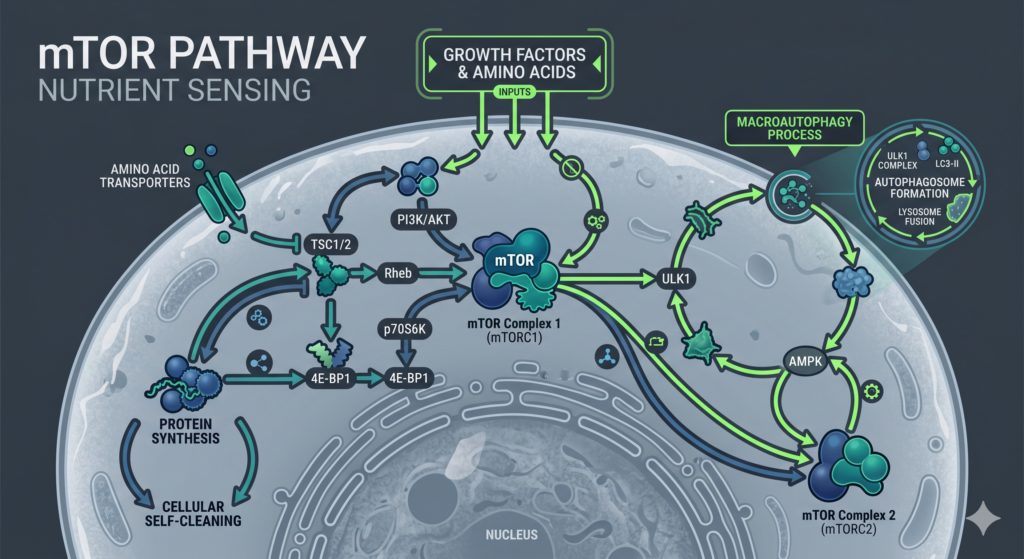
In the rapidly evolving field of canine geroscience, researchers studying rapamycin for dogs are no longer viewing aging as a mysterious, inevitable decline. Instead, modern veterinary science approaches aging as a set of comprehensible and modifiable molecular processes. Among the most intensively studied systems involved in aging across species are nutrient signaling pathways—the intricate cellular networks that regulate metabolism and dictate how a cell responds to food availability.
When exploring biological interventions to extend healthspan, the term rapamycin for dogs frequently surfaces in longevity discussions. At the heart of this research is a central biological master switch: the mechanistic target of rapamycin (mTOR). Understanding how mTOR coordinates cellular growth, waste clearance, and lifespan optimization is fundamental to grasping the future of canine anti-aging strategies. This article breaks down the molecular science of nutrient sensing, the evolutionary role of the somatotrophic axis, and how manipulating these pathways can alter the trajectory of canine aging.
Rapamycin for Dogs and the Science of Nutrient Signaling
Cells do not exist in a vacuum; they must constantly monitor their environment to determine if resources are abundant or scarce. Nutrient signaling pathways are the molecular sensors that detect the presence or absence of proteins, carbohydrates, and fats, adapting the body’s cellular metabolism accordingly. When nutrients are plentiful, these pathways signal the cell to grow, divide, and build tissues. When nutrients are scarce, the signals shift, instructing the cell to halt growth, enter a protective maintenance mode, and clean up internal debris.
In companion animals, deregulated nutrient sensing is classified as an antagonistic hallmark of aging. This means that while highly active nutrient signaling is beneficial and necessary during early life growth, its chronic, unmitigated activation in adulthood eventually becomes destructive, driving cellular exhaustion and age-related functional decline.
The Somatotrophic Axis: GH and IGF-1
The principal system regulating systemic nutrient sensing and growth across mammalian species is the somatotrophic axis. This hormonal network primarily involves:
- Growth Hormone (GH): Secreted by the pituitary gland to stimulate tissue development.
- Insulin-like Growth Factor-1 (IGF-1): A hormone produced primarily by the liver in response to GH stimulation, which acts as a primary driver of cellular proliferation.
- Insulin Signaling: Interconnected pathways that regulate glucose metabolism and energy storage.
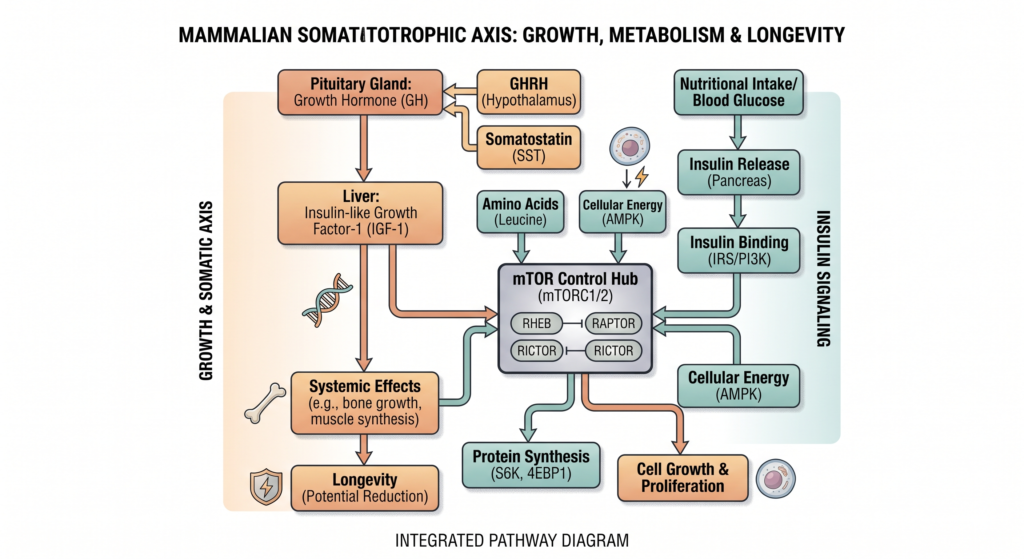
Substantial evidence across multiple species demonstrates that genetic or environmental manipulations that downregulate this axis can significantly prolong lifespan and healthspan. In the canine world, this architecture is vividly illustrated by the stark contrast between small and giant dog breeds. Toy breeds carry a derived, specific allele of the IGF1 gene, whereas giant breeds carry the ancestral, wolf-like allele. This genetic variance heavily dictates adult body size, and because high levels of IGF-1 drive rapid cellular replication and damage accumulation, it directly correlates with the shorter lifespans typically observed in larger dogs.
Rapamycin for Dogs
What is mTOR? Understanding Rapamycin for Dogs and the Master Kinase of Aging
The mechanistic target of rapamycin (mTOR) is a serine/threonine protein kinase that serves as the ultimate downstream integrator within mammalian nutrient-sensing systems. It acts as a cellular manager: when calories and amino acids are high, mTOR turns up protein synthesis, cell growth, and nutrient storage.
Conversely, when energy levels drop, mTOR activity decreases. This downregulation triggers a highly beneficial survival mechanism known as macroautophagy (cellular waste clearance). Macroautophagy allows cells to degrade and remove accumulated intracellular waste, dysfunctional or misfolded proteins, and worn-out organelles.
When macroautophagy becomes disabled due to chronic nutrient oversupply or advanced age, cells lose their ability to self-clean. This failure causes a major loss of proteostasis—resulting in the toxic aggregation of abnormal proteins, cellular senescence, and low-level systemic inflammation (inflammaging).
The Impact of Caloric Excess on Nutrient Signaling
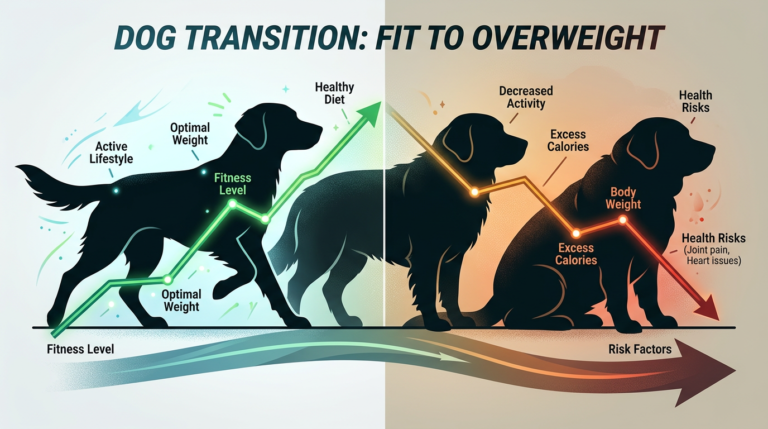
Because nutrient-sensing mechanisms are key targets for efforts to extend lifespan, environmental factors like daily food consumption play a massive role in biological age acceleration. Chronic caloric excess directly alters the metabolic phenotype of companion dogs.
In a landmark, long-term cohort study of Retrievers, one group was fed excess calories throughout life (maintaining a greater-than-ideal body condition score), while a matched group consumed 25% fewer calories (maintaining a lean body condition score). The results were definitive:
Longitudinal Phenotypic Comparison in Retrievers
| Parameter Measured | Caloric Excess Group | Diet-Restricted Group (25% Fewer Calories) |
| Body Condition Score | Overweight / Greater-than-ideal | Distinctly lean throughout life |
| Metabolic Phenotype | Accelerated metabolic deterioration | Preserved metabolic health |
| Orthopedic Health | Increased severity of osteoarthritis | Ameliorated/delayed joint complications |
| Lifespan & Healthspan | Distinctly shorter life and health window | Significantly prolonged lifespan and healthspan |
Maintaining chronic caloric oversupply keeps the mTOR pathway continuously activated, suppressing macroautophagy and preventing cells from clearing somatic damage. Over time, this baseline nutrient deregulatory stress correlates with greater frailty and poorer health outcomes in senior animals.
Rapamycin for Dogs: Geroscience Perspectives
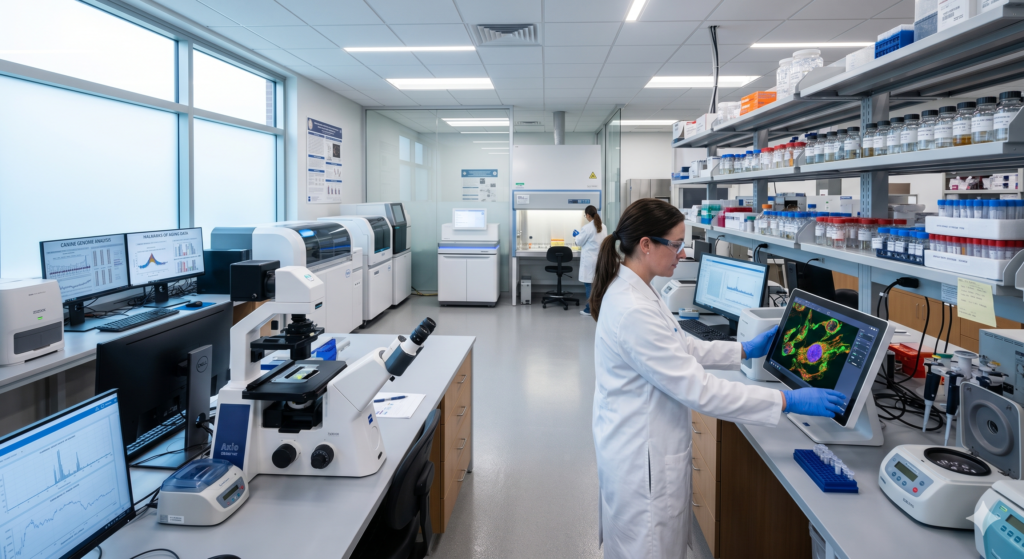
While commercial aging tests and early pharmaceutical discussions regarding rapamycin for dogs and its derivatives are emerging in consumer veterinary markets, prospective evidence regarding direct clinical utility in dogs is still developing. Geroscience researchers are actively investigating how specific diagnostic parameters can safely measure age-related shifts in nutrient axes to guide clinical interventions.
Veterinary professionals emphasize that aging should be viewed as a modifiable process throughout adulthood, rather than an unalterable black box. By understanding that nutrient-sensing pathways can be influenced by diet, targeted caloric management, and metabolic support, caregivers can proactively protect their dogs from developing a high biological age gap early in life.
Frequently Asked Questions (FAQs)
What is the mTOR pathway in dogs?
The mechanistic target of rapamycin (mTOR) is a highly conserved serine/threonine protein kinase that regulates cellular metabolism, protein growth, and nutrient availability. It acts as a central control hub, determining whether a cell should focus on active growth or transition into protective, self-cleaning maintenance modes.
Is rapamycin currently approved as a standard anti-aging drug for dogs?
While geroscience researchers recognize the mTOR pathway as a primary target for extending lifespan, definitive prospective evidence regarding the direct clinical utility and long-term safety of rapamycin as an anti-aging drug for privately owned dogs is still under active investigation. Caregivers should focus on validated lifestyle and metabolic strategies while research continues.
How does calorie consumption affect the hallmarks of aging?
Chronic calorie oversupply constantly stimulates nutrient-sensing pathways like mTOR, which suppresses crucial internal clearance mechanisms like macroautophagy. This leads to a loss of proteostasis, accelerated cell damage accumulation, metabolic phenotypes linked to higher frailty, and an overall shorter healthspan.
What is macroautophagy, and why does it matter for a senior dog?
Macroautophagy is the cell’s internal waste clearance system. It identifies, degrades, and safely removes intracellular waste, toxic protein aggregates, and damaged cellular components. When macroautophagy is impaired or disabled by aging, cells accumulate microscopic damage, driving systemic tissue deterioration.
How does the IGF1 gene affect a dog’s lifespan?
The IGF1 gene regulates Insulin-like Growth Factor-1, a primary growth hormone axis component. Small dog breeds tend to carry a derived allele associated with low IGF-1 expression, which limits skeleton size but preserves cellular longevity. Large breeds typically carry an ancestral allele that drives rapid early-life growth but correlates with accelerated biological aging and a shorter overall lifespan.
Conclusion: Activating the Cellular Pathways to Longevity
Slowing down canine aging requires a deep appreciation for the microscopic pathways operating within your dog’s cells. Nutrient signaling pathways and the mTOR master switch demonstrate that biological decline is not a rigid timeline governed strictly by calendar years. By managing caloric intake, understanding the metabolic vulnerabilities of large breed growth axes, and implementing proactive weight protocols, you can optimize your dog’s cellular environment. Modifying these pathways early in adult life preserves critical organ reserves, supports natural self-cleaning mechanisms, and helps secure a long, vibrant life for your companion.
References
- McKenzie, B. A. (2022). Comparative veterinary geroscience: mechanism of molecular, cellular, and tissue aging in humans, laboratory animal models, and companion dogs and cats. American Journal of Veterinary Research, 83(6), 1-13.
- Moniot, D., Allaway, D., Bermingham, E., Dowgray, N., Gruen, M., Hoummady, S., McKenzie, B., Olby, N. J., & Schoeman, T. (2026). Aging is modifiable: current perspectives on healthy aging in companion dogs and cats. Journal of the American Veterinary Medical Association, 264(2), 234-241.
- McCune, S., & Promislow, D. (2021). Healthy, Active Aging for People and Dogs. Frontiers in Veterinary Science, 8, Article 655191.
- The 12 Hallmarks of Aging: Deciphering the Cellular Clock of Senior Dogs
- Caloric Restriction vs. Lifespan: What Two Decades of Retriever Research Proves
- The Gut-Brain-Microbiome Connection in Senior Pet Behavioral Profiles
- American Veterinary Medical Association: For verified scientific updates in Currents in One Health geroscience publishing.
- The Dog Aging Project Consortium: For prospective insights regarding epigenetic modeling and genetic determinants of healthspan.




One Comment