
Every dog owner wants the best for their aging companion — but without the right senior dog health tips, it’s easy to miss the signs that matter most. As modern canine biotechnology and veterinary geroscience advance, scientists are discovering a heartbreaking reality: many of the changes we dismiss as “just normal aging” are actually silent cries for help.

When your senior dog stops jumping onto the couch, hesitates before the stairs, or sleeps twenty hours a day, are they simply enjoying retirement — or are they masking chronic discomfort? The most practical senior dog health tip here: don’t wait for dramatic symptoms. By the time a dog shows obvious signs of pain, the condition is often already advanced.
Drawing directly from groundbreaking clinical studies published in Frontiers in Behavioral Neuroscience and Animals, let’s dismantle the five most dangerous misconceptions about canine aging and explore how you can accurately measure your dog’s true well-being.
5 Dangerous Aging Myths You Need to Stop Believing
Misconception 1: “My Dog Isn’t Crying or Limping, So They Aren’t in Pain”
This is perhaps the single most common — and dangerous — myth in pet ownership. As humans, we vocalize our discomfort. We expect our dogs to do the same. But canine biology works very differently.
Evolutionary biology dictates that showing vulnerability in the wild makes an animal a prime target for predators. Even though our companion dogs have slept on memory foam mattresses for generations, their deep-rooted genetic instincts remain intact. They will mask physical discomfort until it becomes absolutely unbearable.
In a landmark clinical study published in Frontiers in Behavioral Neuroscience — An exploratory study of behavioral, cognitive, physiological, and microbiota profiles in senior dogs — veterinary researchers used the Helsinki Chronic Pain Index (HCPI) to evaluate senior companion dogs living in typical home environments.
The results were staggering: 100% of the senior dogs evaluated scored well above the clinical threshold for chronic pain — yet their owners had brought them in for routine health checks, completely unaware.
Limping and whining are signs of acute pain. Chronic pain — such as the slow, grinding discomfort of degenerative joint disease — presents itself through a gradual, quiet withdrawal from daily life.
Misconception 2: “They’re Just Sleeping More Because They’re Old”
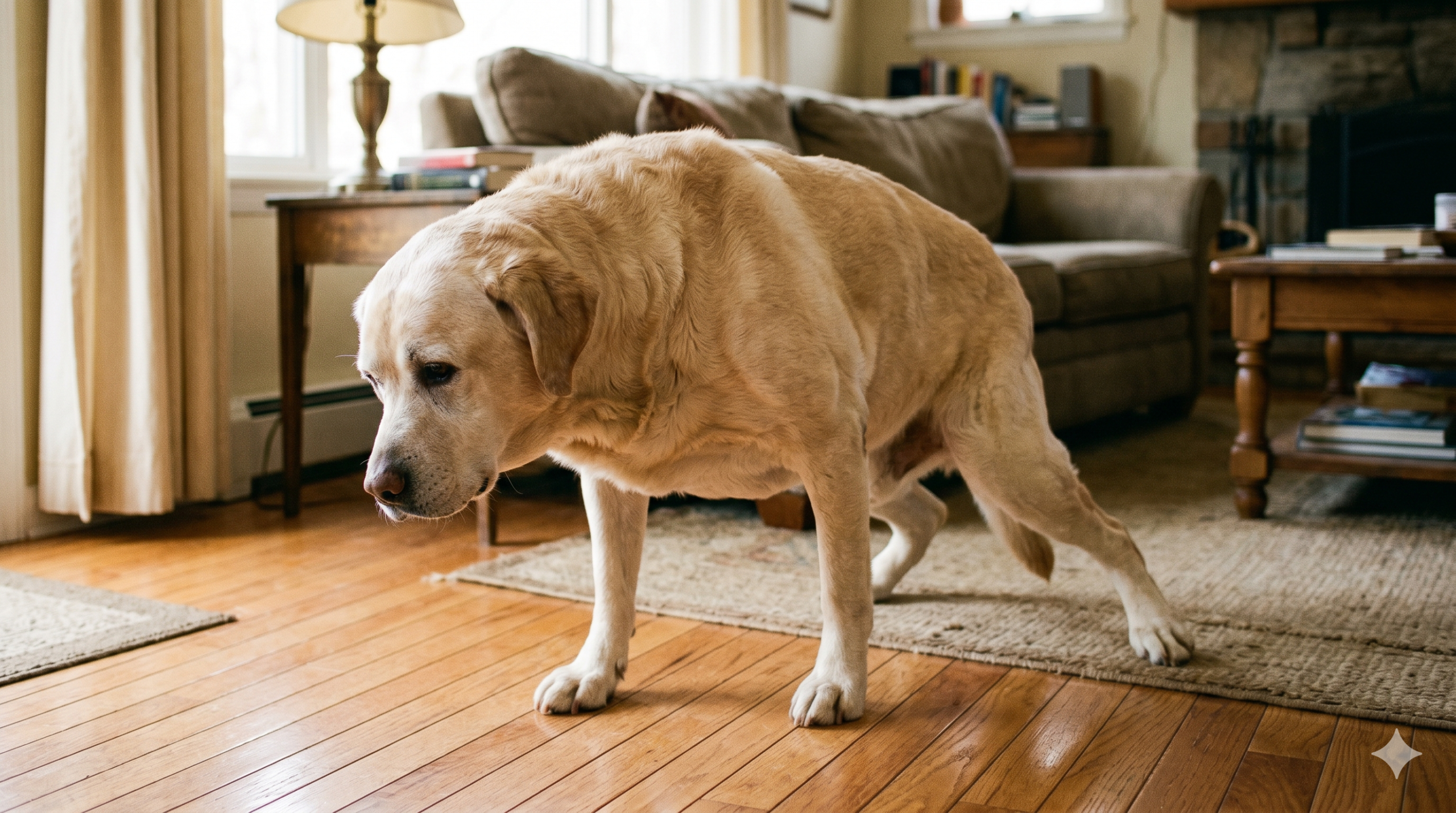
One of the most overlooked senior dog health tips is this: excessive daytime sleep is often a pain-mitigation tactic, not a personality quirk.
Think about it from your dog’s perspective. If every movement — lying down, adjusting positions, rising from a slick hardwood floor — induces a micro-flash of joint inflammation, the most logical biological response is to minimize movement entirely.
A 2024 study published in Animals, titled Psychometric Testing and Validation of the Italian Version of the Helsinki Chronic Pain Index (I-HCPI) in Dogs with Pain Related to Osteoarthritis, tracked how chronic discomfort profoundly alters a pet’s quality of life, leading to:
- A dramatic loss of interest in the surrounding environment
- Decreased social interactions with family members
- A severe reduction in the overall enjoyment of life
When senior dogs’ pain profiles were effectively managed with targeted veterinary care, their daytime “lethargy” frequently vanished — and their families reported a sudden resurgence of playfulness and curiosity.
Misconception 3: “My Vet Would Have Caught It at the Annual Check-Up”
We trust our veterinarians deeply — and rightly so. However, an annual exam is merely a snapshot in time, and a highly artificial one at that.
When your dog enters a veterinary clinic, their sympathetic nervous system goes into overdrive. The unfamiliar smells, the stainless-steel scales, and the presence of strangers trigger a massive surge of adrenaline — a potent natural analgesic that temporarily dulls pain pathways.
A senior dog who struggles to stand up at home might trot into the clinic smoothly and seem entirely fine during a ten-minute exam. This is why modern veterinary medicine is shifting heavily toward Clinical Metrology Instruments (CMIs) — structured questionnaires completed by the person who knows the dog best: you.
Your observations in the comfort of your living room are far more valuable for diagnosing chronic pain than any brief clinic visit.
Misconception 4: “My Dog Still Wags Their Tail, So Their Quality of Life Is Fine”
One of the most important senior dog health tips is this: a tail wag does not mean a dog is pain-free. It simply means they are happy in that exact moment of human connection.
Dogs are remarkably resilient creatures. Their entire evolutionary history is intertwined with a profound desire to please their human companions. A dog will frequently push past severe physical discomfort to join you on a walk or greet you enthusiastically at the door — because the emotional reward outweighs the physical cost.
In the Frontiers in Behavioral Neuroscience exploratory study, researchers noted a fascinating paradox. While objective testing proved every single senior dog was suffering from significant chronic pain, owners simultaneously filled out Quality of Life (QOL) surveys stating their dogs had “good overall well-being.”
Relying solely on an empty food bowl or a wagging tail means you will miss the early, critical windows where medical intervention can drastically extend your dog’s healthy lifespan.
Misconception 5: “Arthritis Is Just a Joint Problem — It Doesn’t Affect Overall Health”
Many owners view canine osteoarthritis as an isolated mechanical issue. But this is a profound misunderstanding of systemic physiology.
Chronic joint pain is driven by widespread, low-grade chronic inflammation — what longevity researchers call “inflammaging.” Inflammatory cytokines produced in a damaged hip or knee joint travel through the bloodstream, interacting with the immune system, altering organ function, and shifting the delicate balance of the gut-brain axis.
A 2026 senior dog profile study uncovered a direct relationship between chronic pain scores, systemic immune shifts (specifically Th2 polarization), and a disrupted gut microbiota. When an animal is under constant inflammatory stress from unmanaged pain, the central nervous system alters gut permeability, depletes beneficial bacteria like Lachnospiraceae, and encourages inflammatory microbes like Prevotella.
Unmanaged joint pain isn’t just making your dog stiff — it is actively degrading their immune system and accelerating biological aging across their entire body.
Senior Dog Health Tips: How to Test Your Dog at Home
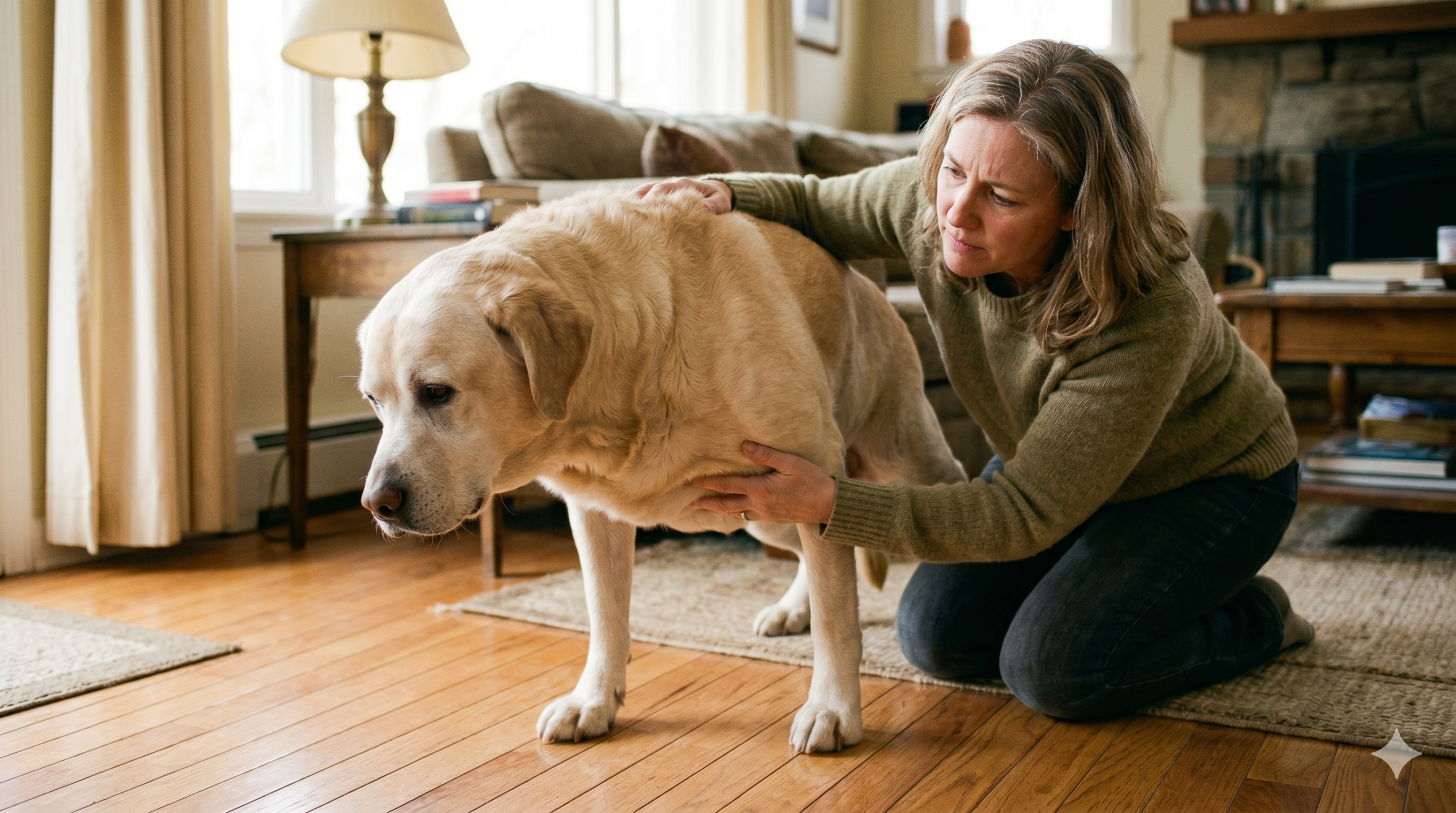
The most practical senior dog health tip here: don’t wait for dramatic symptoms.
Now that we know we cannot simply rely on intuition, how can we objectively evaluate our senior companions?
Veterinary scientists use the Helsinki Chronic Pain Index (HCPI), rigorously validated by the University of Perugia and the University of Helsinki, with a 95% accuracy rate in distinguishing pain-free dogs from those suffering from hidden chronic discomfort.
Grade the following 11 items on a scale from 0 (Normal) to 4 (Severe) based on your dog’s behavior over the past week:
Mood and Behavior
- Mood: Bright, alert, and affectionate (0) → Downcast, quiet, and withdrawn (4)
- Play: Initiates play eagerly (0) → Completely ignores toys and invitations (4)
- Vocalization: Does your dog whine, groan, or whimper when moving or settling?
Locomotion and Willingness to Move
- Walking: Walks evenly and effortlessly (0) → Hesitates, limps, or refuses (4)
- Trotting: Stride is fluid (0) → Hops and skips awkwardly (4)
- Galloping: Sprints comfortably (0) → Completely avoids running (4)
- Jumping: Jumps easily (0) → Hesitates, whines, or requires lifting (4)
Ease of Motion
- Lying Down: Settles smoothly (0) → Circles endlessly, drops heavily, or groans (4)
- Getting Up: Springs up effortlessly (0) → Pushes up stiffly with front legs (4)
- Movement After Rest: Walks normally right away (0) → Limps and stiffens for the first few minutes (4)
- Movement After Exercise: Perfectly fine the next day (0) → Exhausted, stiff, and reluctant to move (4)
Your Score:
- 0–11: Your dog falls within the healthy, pain-free baseline. ✅
- 12 or higher: Your dog is highly likely to be experiencing chronic pain. ⚠️
What to Do If Your Dog Scores 12 or Higher
Aging is an inevitable, beautiful part of life’s journey. But pain is a pathology — not an age group.
If your senior dog scored 12 or higher on the Helsinki Index, do not despair. Acknowledge it as an incredible opportunity. By working closely with your veterinarian to integrate targeted pain-relief protocols, weight management strategies, and advanced nutritional interventions that support the gut-brain axis, you can lift the invisible weight of chronic inflammation from your dog’s shoulders.
Let’s stop normalizing the decline of our older dogs. They gave us their youth — the very least we can do is give them a comfortable, joyful, and dignified retirement.
References
- della Rocca, G., Schievano, C., Di Salvo, A., Hielm-Björkman, A. K., & della Valle, M. F. (2024). Psychometric Testing and Validation of the Italian Version of the Helsinki Chronic Pain Index (I-HCPI) in Dogs with Pain Related to Osteoarthritis. Animals, 14(1), 83. https://doi.org/10.3390/ani14010083
- Saral, B., Atilgan, D., Adiay, D., Filazi, N., Ozturk, H., Kismali, G., Da Graca Pereira, G., Ozkul, A., & Salgirli Demirbas, Y. (2026). An exploratory study of behavioral, cognitive, physiological, and microbiota profiles in senior dogs. Frontiers in Behavioral Neuroscience, 20, 1689807. https://www.frontiersin.org/articles/10.3389/fnbeh.2026.1689807/full




2 Comments