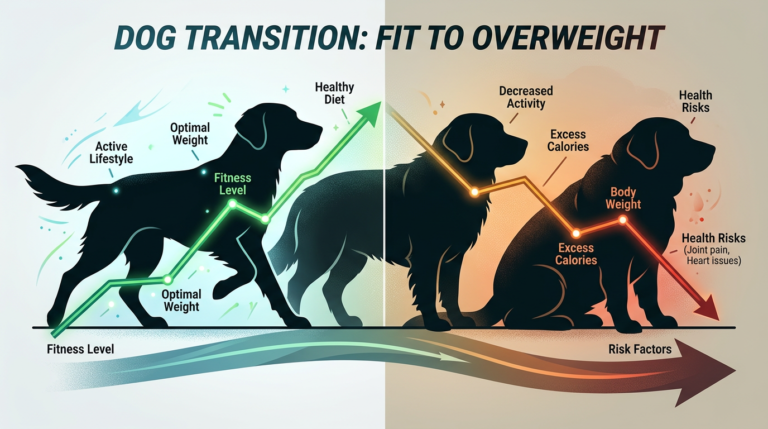
For us dog owners, the greatest wish is simple. We want our loyal companions to live as long, healthy, and pain-free as possible. As biotechnology and multi-omics research advance, we can see the genetic, environmental, and metabolic factors behind dog longevity far more clearly. However, beyond the complex molecular components of the laboratory, one critical biological parameter sits entirely in our hands every day. That parameter is body condition, or simply weight management.
Many owners find a slightly chubby, “fluffy” dog adorable. Yet veterinary medicine now classifies obesity very differently. In fact, the excessive expansion of white adipose tissue (WAT) is a destructive disease. It is independent, chronic, and it drives systemic low-grade inflammation. Therefore, in this VetAgens article, we examine a striking clinical study of more than 50,000 dogs from a huge North American hospital network. As a result, we can show exactly how, and by how many years, excess weight shortens a dog’s life.

Big Data Proof: The 50,787-Dog Longevity Study
To measure the direct effect of mid-life excess weight (between 6.5 and 8.5 years of age), researchers ran a huge retrospective case-control study. In total, it covered roughly 900 veterinary hospitals (Banfield Pet Hospitals) across North America. The study included 50,787 neutered dogs from 12 popular breeds. Therefore, it stands as one of the strongest pieces of evidence in the medical literature. Above all, it reflects the real lifespan of home-living pet dogs.
The statistical results leave no room for debate. Across every breed studied, overweight dogs faced a far higher instant risk of death than ideal-weight peers. Moreover, this pattern held true at every age range throughout life.
Smaller Breeds Lose More Years of Life
One of the most shocking findings concerns body size. Specifically, the scale of obesity-driven lifespan loss changes radically by breed and size class. Interestingly, the metabolic burden of excess weight hits miniature and small breeds far harder than large ones. As a result, small dogs lose far more years.
Hazard Ratios: According to the Cox proportional hazards analysis, an overweight Yorkshire Terrier carries an instant death risk 2.86 times higher than an ideal-weight one. For the Chihuahua, this ratio reaches 2.42 times, and for the Dachshund 2.77 times. By contrast, the large German Shepherd sits at just 1.35 times.
The table below summarises the median lifespan gap between ideal and overweight dogs across popular breeds.

| Breed | Size Class | Median Lifespan (Ideal Weight) | Median Lifespan (Overweight) | Net Lifespan Lost |
|---|---|---|---|---|
| Yorkshire Terrier | Class I (Very Small) | 16.2 years | 13.7 years | 2 years 6 months |
| Dachshund | Class III (Medium) | 16.4 years | 14.1 years | 2 years 4 months |
| Chihuahua | Class I (Very Small) | 16.0 years | 13.9 years | 2 years 1 month |
| Beagle | Class II (Small–Medium) | 15.2 years | 13.2 years | 2 years 0 months |
| American Cocker | Class II (Small–Medium) | 14.9 years | 13.4 years | 1 year 6 months |
| Golden Retriever | Class V (Large) | 13.3 years | 12.5 years | 9–10 months |
| Labrador Retriever | Class V (Large) | 13.3 years | 12.7 years | 7 months |
| German Shepherd | Class V (Large) | 12.5 years | 12.1 years | 5 months |
The data proves a clear point. In small dogs, obesity steals an average of 2 to 2.5 years of life. In large breeds, the loss ranges from 5 to 10 months. However, dogs already live short lives compared with humans. Therefore, even a loss measured in months feels huge to a devoted owner.
How Obesity Shortens Dog Longevity at the Biological Level
Two core mechanisms explain why excess weight cuts a dog’s median lifespan. Understanding both helps protect long-term dog longevity.
Systemic inflammation and chronic disease. Overgrown white adipose tissue (WAT) constantly releases pro-inflammatory cytokines. As a result, it creates chronic, low-grade systemic inflammation. In turn, this state directly triggers insulin resistance, type 2 diabetes, cardiovascular dysfunction, respiratory problems, kidney dysfunction, and certain cancers. For a deeper look at this process, see our guide on weight gain after neutering.
Osteoarthritis and euthanasia decisions. Excess weight raises the mechanical load on the joints. Therefore, it starts and worsens orthopaedic conditions, especially osteoarthritis, at a very early age. Eventually, many dogs suffer chronic pain and lose mobility. Sadly, owners then face euthanasia decisions on veterinary advice. In other words, obesity may not kill directly, yet it ends life indirectly through painful disease.
The State of Türkiye’s Dog Population
A recent university-level survey shows that Türkiye is not immune to this global crisis. According to the data, 30% of dogs in the country fall into the overweight or obese category.
The same study found a revealing gap. Although 95% of owners check the contents of their dog’s food, many still make serious mistakes in practice. For example, they struggle with calorie density, portion control, and exercise. In particular, 39% give table scraps from their own plates. Furthermore, 69% use treats without counting calories. Clearly, these human-driven factors are the main triggers of weight gain in dogs. To see how much this costs, read our overview of how excess weight shortens pet lifespan.
VetAgens Tips to Extend Dog Longevity

The number of fit, healthy, and pain-free years you share with your dog lies directly in your hands. Therefore, take these science-backed steps right away.
- Control the portions. Avoid ad libitum feeding, and never keep the bowl constantly full. Instead, weigh the daily amount on a kitchen scale and split it into meals.
- Limit treats and table scraps. Stop giving scraps from your own plate completely. In addition, subtract the calories of small training treats from the main daily portion to keep the balance.
- Make brisk exercise a routine. Apartment dogs have limited space to move. Therefore, plan daily brisk walks and runs suited to your dog’s breed and age, and raise their energy expenditure.
Ultimately, the science is clear. Smart weight management is one of the most powerful tools for dog longevity. Start today, and give your loyal friend more healthy years.
References
Demir İE, Altaçlı S (2024). Evaluation of Obesity in Cats and Dogs Together with Owner Profiles. Van Veterinary Journal, 35 (1), 38–46. DOI: https://doi.org/10.36483/vanveti.1359331
Çağlar C, Kara HH (2026). A Bibliometric Analysis of Studies on Nutrition and Obesity. Gümüşhane University Journal of Health Sciences, 15(1): 76–89.
Salt C, Morris PJ, Wilson D, Lund EM, German AJ (2019). Association between life span and body condition in neutered client-owned dogs. Journal of Veterinary Internal Medicine, 33:89–99. DOI: 10.1111/jvim.15367