For decades, we’ve accepted that our dogs aging faster than us was an unchangeable law of nature. We watched them slow down, gray, and weaken, believing it was just “part of the journey.” But what if science is no longer just watching aging — it’s starting to intervene?
We are currently witnessing a revolution in Canine Geroscience. Breakthrough initiatives like the Dog Aging Project (DAP) are treating aging not as a destiny, but as a biological process that can be slowed, paused, or even partially reversed. Because dogs share our homes, our environments, and even our stressors, they are the ultimate partners in unlocking the secrets of longevity — for both species.
This is a synthesis of cutting-edge research published in prestigious journals like GeroScience (2025) and Aging Cell. Before we dive in, let’s build our Science Dictionary.
📖 Science Dictionary — Key Terms
Metabolomics: Think of it like a car’s exhaust analysis — it studies the tiny molecules (metabolites) produced when cells work, revealing the body’s real-time biological status.
Microbiome: A hidden “metropolis” of trillions of microbes in your dog’s gut that manages everything from immunity to mood — and now, biological aging.
Senolytics & Autophagy: Autophagy is the body’s “recycling plant” that clears damaged cellular components. Senolytics are the “cleanup crew” that removes “zombie cells” — senescent cells that drive inflammation and accelerate aging.
Breakthrough 01 — The Gut’s “Youth Clock”: The Microbiome Fingerprint
Research recently published on bioRxiv (“Mapping the canine microbiome”) has revealed a striking pattern: as dogs age, their gut diversity typically decreases. However, in dogs that age exceptionally well, their microbiome becomes increasingly “unique” — like a healthy biological fingerprint that resists the entropy of time.
The breakthrough lies in what scientists have built on top of this insight: a “Metagenomic Clock” powered by machine learning. By simply analyzing the bacteria in a dog’s gut, researchers can now predict its biological age with startling accuracy — a tool that may one day become as routine as a blood pressure check at the vet.
Breakthrough 02 — The Silent Signal in Blood: Protein Catabolites and Biological Age
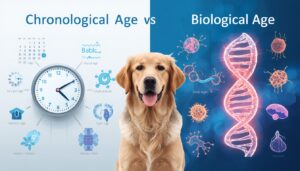
A massive metabolomic analysis featured in Aging Cell (2025) has identified a compelling new “smoke signal” for aging: ptmAA (post-translationally modified amino acids). These are essentially biochemical “trash” left behind when proteins break down — and their accumulation tells a remarkably precise story about how fast a dog’s body is actually aging.
To understand why this is a game-changer, we need to distinguish between two fundamentally different types of age:
| Feature | Chronological Age | Biological Age |
|---|---|---|
| Definition | Calendar years since birth | Actual state of cells and organs |
| Measurement | Birth certificate / ID | ptmAA, epigenetic clocks, microbiome clocks |
| Variability | Fixed — cannot be changed | Can be slowed via lifestyle, diet, and intervention |
| Scientific authority | Standard veterinary medicine | Aging Cell (2025) research |
Breakthrough 03 — The Miracle Molecule: Rapamycin and the TRIAD Study
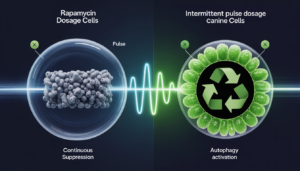
If there is a “celebrity molecule” in longevity science right now, it is Rapamycin. Originally developed as an immunosuppressant for organ transplant patients, this compound acts as a biological switch — one that turns off “growth mode” and turns on “repair mode” (autophagy) at the cellular level.
The TRIAD study (Test of Rapamycin in Aging Dogs), led by researchers at Texas A&M University and recently expanded with a $7 million NIH grant, suggests that how we administer this molecule is everything:
| Parameter | Continuous dosage (daily) | Intermittent dosage (weekly — TRIAD model) |
|---|---|---|
| Cellular effect | Constant growth suppression | Autophagy (recycling) trigger |
| Immune system | Higher risk of suppression | Immune modulation (safer) |
| Side effects | Potential metabolic disruption | Minimal to no reported side effects |
| Primary goal | Disease treatment (e.g., cancer) | Longevity — healthy life extension |
“It seems to mimic the effects that happen in people or animals who do intermittent fasting. There is a lot of interest in intermittent fasting as a technique that can improve health, particularly healthy aging, and some of the pharmaceutical effects of rapamycin make the same changes at the cellular level.”
— Dr. Kate Creevy, TRIAD co-principal investigator, Texas A&M
Early findings indicate improved heart function in older dogs receiving intermittent “weekly pulses.” Think of it as the “fasting mimicry” in a pill — triggering the same cellular cleanup that caloric restriction achieves, without the dog skipping a meal. The TRIAD study is slated to conclude in November 2029, with over 50,000 dogs enrolled in the broader Dog Aging Project.
Breakthrough 04 — Shocking Truths About Diet — and Yes, About Poop
Science can be gross. But it’s always honest.
Studies show that dogs who engage in coprophagia (poop-eating) actually display incredibly high microbiome diversity. While this behavior is not something to encourage, it is a vivid illustration of how powerfully the gut microbiome reflects environmental exposures — and how urgently we need better tools to shape it intentionally.
Perhaps more practically important: many owners believe home-cooked diets are always superior to commercial options. However, researchers found that dogs on home-cooked meals often had higher levels of Clostridium perfringens compared to those on high-quality commercial diets — a bacterium associated with gastrointestinal disease and potentially harmful microbiome shifts.
Breakthrough 05 — Losing the “Inflammation Warriors”: The Gut Bacteria That Keep Dogs Young
As dogs age, they lose specific “good guys” in their gut — most notably Prevotella and Holdemanella biformis. These aren’t just passengers; they are active defenders against one of aging’s most insidious mechanisms.
These bacteria produce anti-inflammatory short-chain fatty acids that prevent “Inflammaging” — the chronic, low-grade systemic inflammation that quietly drives age-related diseases including arthritis, cognitive decline, and organ deterioration. When these microbial warriors are lost, the fire burns hotter and longer.
Supporting these bacteria with targeted prebiotics (the dietary fibers that feed beneficial microbes) is emerging as a crucial — and actionable — strategy for senior dog health. This is a rapidly evolving area; watch for peer-reviewed guidance from the Dog Aging Project in coming years.
Frequently Asked Questions
Is rapamycin safe for dogs?
Based on current TRIAD study data, intermittent (once-weekly) low doses of rapamycin appear to be well-tolerated in healthy middle-aged dogs, with minimal reported side effects. However, rapamycin is not yet approved for canine longevity use, and it should only be administered under veterinary supervision. The TRIAD study is ongoing through November 2029.
What is the Dog Aging Project?
The Dog Aging Project (DAP) is a large-scale, NIH-funded citizen science initiative launched in 2019, jointly led by the University of Washington and Texas A&M University. It has enrolled over 50,000 companion dogs to study the biological and environmental factors that influence canine longevity — with significant implications for human aging research as well.
What is biological age vs. chronological age in dogs?
Chronological age is simply how many years your dog has been alive. Biological age reflects the actual health state of your dog’s cells and organs — measured through biomarkers like ptmAA, epigenetic clocks, and microbiome analysis. A 10-year-old dog could have the biological age of an 8-year-old with the right interventions.
What does the TRIAD study measure?
TRIAD tests whether once-weekly rapamycin extends lifespan and improves healthspan in dogs aged 7 years and older. Secondary endpoints include heart function, kidney markers, and arthritis indicators. It is the first rigorous pharmacologic test of a longevity intervention with lifespan endpoints conducted outside a laboratory setting in any species.
Can diet affect my dog’s biological age?
Yes — significantly. Diet shapes gut microbiome diversity, which is now one of the strongest measurable predictors of biological aging in dogs. High-quality, balanced diets support healthier microbiome profiles. If feeding a home-cooked diet, consult a board-certified veterinary nutritionist to avoid inadvertent nutritional gaps.
The New Era of Pet Parenthood
Reversing the biological clock is no longer the stuff of science fiction. Our dogs are pioneers helping us decode the mystery of life itself — and the science supporting them has never been more rigorous, more funded, or more promising.
The five breakthroughs above aren’t isolated findings. They are converging signals pointing toward a new paradigm in veterinary medicine: one where we don’t just treat disease when it appears, but actively manage the pace of aging — for dogs, and ultimately for ourselves.
What about you? Have you tried any specific longevity supplements or diets for your dog? Share your experiences in the comments below — and follow VetAgens for continuing coverage as the TRIAD results emerge.
Disclaimer: This article is for informational purposes based on current academic research and does not constitute veterinary advice. Always consult with a licensed veterinarian before starting any new medication, supplement, or dietary protocol for your dog. Rapamycin is an investigational drug for canine longevity and is not approved for this purpose by the FDA or any regulatory body as of the date of publication.