Canine longevity is a top priority for modern pet parents who want to ensure their four-legged family members live the longest, healthiest lives possible. Over the last few decades, our relationship with our dogs has undergone a massive evolution. They aren’t just backyard guardians anymore; they are our bed-sharing, stroller-riding, deeply loved family members. Naturally, this shift has triggered a booming scientific quest to answer one ultimate question: How can we keep our best friends by our side for as long as possible?
Modern veterinary medicine is shifting away from just treating diseases as they pop up. Instead, science is looking upstream—focusing on delaying cellular aging and expanding what scientists call “healthspan” (the period of life spent in good health, not just survival).
Drawing from cutting-edge research, including the massive, ongoing Dog Aging Project, let’s dive into the fascinating science of canine longevity and explore the actionable steps you can take today to give your pup more tomorrow.
1. Lifespan vs. Healthspan in Canine Longevity
When we talk about canine longevity, we need to separate two crucial concepts: lifespan (the total number of years your dog is alive) and healthspan (the years they spend active, vibrant, and pain-free). No one wants to prolong a dog’s life if those extra years are filled with chronic pain or cognitive decline. The goal is a long and high-quality life.
The Big Dog, Short Life Paradox
In most of the animal kingdom, bigger means longer-lived (think elephants vs. mice). But dogs defy nature’s rules. Inside the canine world, larger size translates to an accelerated biological clock. Giant breeds simply age at a much faster rate on a cellular level.
[Image Suggestion: An elegant infographic contrasting breed size categories with their aging curves and healthspan milestones]
| Breed Category | Weight Range | Average Lifespan | Rate of Senescence (Aging) |
| Toy Breeds | < 5.5 kg (< 12 lbs) | 14 – 16 Years | Slow & Steady |
| Small Breeds | 5.5 – 11.5 kg (12-25 lbs) | 12 – 15 Years | Slow |
| Medium Breeds | 11.5 – 22.5 kg (25-50 lbs) | 10 – 13 Years | Linear / Standard |
| Large Breeds | 22.5 – 45 kg (50-100 lbs) | 8 – 11 Years | Fast |
| Giant Breeds | > 45 kg (> 100 lbs) | 6 – 9 Years | Highly Accelerated |
Quick Tip: Data consistently shows that mixed-breed dogs outlive their purebred counterparts of a similar size by about 1 to 2 years. This is largely due to “hybrid vigor”—a lower risk of inheriting the concentrated genetic disorders common to highly selected gene pools.
2. Under the Hood: Cellular & Genetic Aging
Why do giant breeds age so fast? It mostly boils down to a biological pathway governed by Insulin-like Growth Factor 1 (IGF-1). Because giant puppies have to grow at a breakneck speed, their IGF-1 levels are sky-high. While this drives rapid bone and tissue growth, it also speeds up cell division, leading to higher oxidative stress and cellular wear-and-tear (cellular aging in dogs).
But here is the exciting news: scientists are now mapping canine “epigenetic clocks.” By looking at DNA methylation patterns, researchers can determine a dog’s true biological age, not just their chronological age. This breakthrough is paving the way for targeted anti-aging interventions—including clinical trials evaluating longevity drugs like Rapamycin—which may soon allow us to slow down the biological clock itself.
3. How the Dog Gut Microbiome Impacts Canine Longevity
If genetics is the gun, environment and lifestyle pull the trigger. And when it comes to lifestyle, nothing is more powerful than what you put in your dog’s bowl.
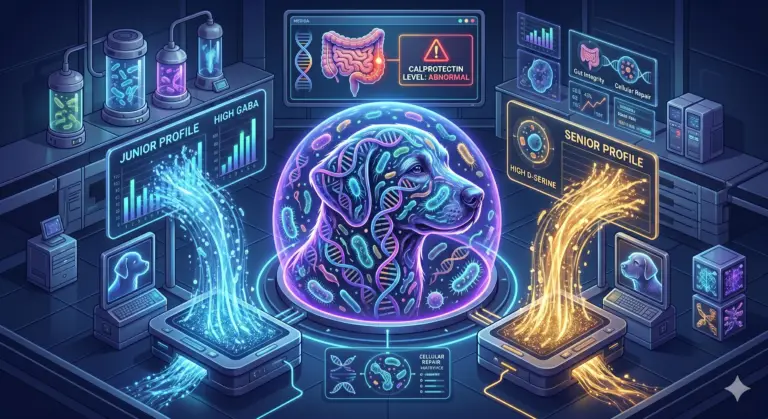
Your dog’s gut microbiome is home to over 70% of their immune system. A disrupted, unbalanced gut leaks pro-inflammatory markers into the bloodstream, driving systemic, low-grade chronic inflammation—the literal fuel for aging.
The Life-Extending Magic of Calorie Restriction
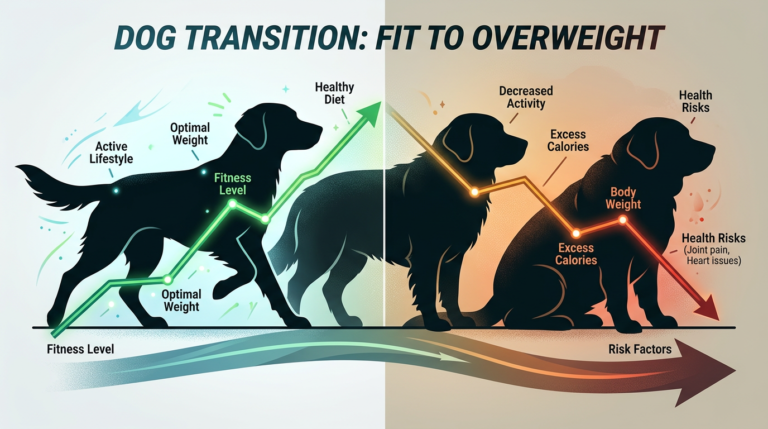
One of the most famous, decades-long studies in veterinary history followed two groups of Labrador Retrievers. One group ate a standard diet, while the other was fed a slightly calorie-restricted diet to maintain a lean body condition score (BCS). The result? The lean dogs lived an average of 2 years longer than their heavier peers. Keeping your dog lean delays the onset of osteoartrit, insulin resistance, and cardiovascular decline.
Feeding Frequency: Is Less More?
Recent epidemiological data coming out of the Dog Aging Project has turned heads in the veterinary community. Analyzing thousands of companion dogs, researchers found that dogs fed once a day (a form of intermittent fasting/caloric control) scored significantly lower for cognitive decline, metabolic disorders, and gastrointestinal issues compared to dogs fed multiple times a day. While you should always consult your vet before altering schedules, it shows that how we feed is just as vital as what we feed.
4. Keeping the Brain Sharp and the Body Moving
Physical exercise is an obvious win for joint and muscle health, but its impact on cell biology is even cooler: it triggers mitophagy, the process where cells clean out their old, damaged powerhouses (mitochondria) and build fresh ones.
- Beating Canine Dementia: Just like humans, senior dogs face the threat of Alzheimer’s-like symptoms, clinically known as Canine Cognitive Dysfunction (CCD). To protect your dog’s brain, you have to use it. Mental enrichment—like nose-work games, puzzle feeders, and learning new commands—keeps synaptic plasticity alive well into their golden years.
- The Power of Companionship: Dogs are deeply social creatures. Studies show that a rich social environment, a strong human-animal bond, and low-stress home lives directly keep cortisol (stress hormone) levels low, protecting the immune system from premature exhaustion.
5. Preventative Vet Care & The Spay/Neuter Timing Debate
Routine preventative care—like senior blood panels and early diagnostic screenings—is non-negotiable for expanding healthspan. Catching kidney or metabolic changes early gives you a massive head start. However, when it comes to reproductive health, the science has become highly nuanced.
The Longevity Metrics of Altering
Massive population studies show a clear trend: sterilized (spayed or neutered) dogs tend to live significantly longer than intact dogs. The statistical lifespan increases are impressive:
- Spayed Female Dogs: See a 23% increase in lifespan.
- Neutered Male Dogs: See an 18% increase in lifespan.
However, timing is everything. For large and giant breeds, sex hormones play a critical role in bone growth plate closure. Altering them too early (before joint growth is complete) can spike their risk for joint disorders and certain cancers like osteosarcoma. Work closely with a vet who looks at your dog’s specific breed and lifestyle rather than using a one-size-fits-all timeline.
Conclusion: The 5 Golden Rules of Canine Longevity
You cannot change the DNA your dog was born with, but you hold total control over their epigenetics and daily environment. To optimize your dog’s healthspan and give them the best shot at a long, happy life, stick to these five pillars:
- Keep them lean: Ditch the heavy treats; a lean dog is a long-lived dog.
- Nurture the gut: Feed high-quality, easily digestible proteins and prebiotic fibers to protect the microbiome.
- Exercise the mind: Pair daily walks with puzzle toys and scent games to ward off CCD.
- Guard the teeth: Periodontal disease isn’t just bad breath—it introduces bacteria straight into the bloodstream, damaging the heart and kidneys.
- Be proactive: Prioritize annual or bi-annual veterinary wellness blood screens to catch subtle internal shifts before they become clinical symptoms.
Scientific Bibliography & References
- Dog Aging Project Consortium. (2022-2026). Longitudinal studies on genetic, environmental, and lifestyle factors in companion canine populations. dogagingproject.org.
- PMC / NIH Review. Diverse breeds, diverse lifespans: understanding longevity in domestic dogs. PubMed Central (PMC12520860).
- PMC / NIH Narrative Review. Lifestyle factors affecting aging and healthspan in dogs and cats. PubMed Central (PMC12520850).
- Frontiers in Veterinary Science. Demographic Change Across the Lifespan of Pet Dogs and Their Impact on Health Status. (Volume 5, Article 200).
- Kraus, C., et al. Why big dogs die young: the evolutionary trade-off between growth and longevity in the domestic dog. The American Naturalist.